Showing posts with label Horror. Show all posts

Film Review: Maggie (2015)

Copyright: Lionsgate Films
We didn’t realize it, but a zombie apocalypse is an apparently full of depressive potential. Sure, the plots often grazed depression in these types of films, but mostly while their primary emotions are based on anxiety and the need to stay alive. In Maggie, however, the focus is exclusively on depressive shades of a deadly virus outbreak, which turns people into flesh-craving monsters.

To add to the unexpected weirdness of this idea, the film introduces Arnold Schwarzenegger as Wade, the bewildered father of the main character, a girl called Maggie, who gets infected with the virus and has only weeks before she turns into a zombie. On their secluded farm, father and daughter prepare for the inevitable while Maggie says goodbye to her memories and everything around here.

When Henry Hobson directed this film, I’m certain he wanted to make something original above everything else. He managed to do this, but also to cram some nice melancholic tones in this primarily depressive story about loss and change.

At the same time, I’m sure he enraged many people and will enrage others in the future who will be expecting to see Arnold blowing away zombies. In the film, Schwarzenegger is a quiet, truck-repairing type of guy who is preparing to put his dead daughter into the ground or do something even worse. He runs with this notion neither too badly not exactly excelling in his role. Instead, he does okay, which can be said for the entire movie as well.

Hobson obviously has some ideas and Maggie shows this, but as a whole, it keeps an aura of casual meekness which stops it from making some serious emotional impacts, unlike, for example, The Retrieval, which shares its toned-down narrative approach and bleakness. Abigail Breslin is really sharp as Maggie, but the film somehow is not. It’s good that Hobson did not try to say anything about the genre of zombie movies as a whole and simply drove the plot a personal story. It might not have Schwarzenegger raining destruction, but at least it is trying to destroy our emotions by showing a really horrible few weeks for a single family.

Film Review: The Lazarus Effect (2015)

Copyright: Relativity Media
Like the recent horrors which were both low budget (Spring) and really AAA level (Poltergeist) this film is also significantly uneven. From the basic story of a lab team that developed a cure for death, The Lazarus Effect quickly slips into a thriller of demonic possession and personal hellscapes. The speed of this transition is not only narrative, but also quite literal, because the entire film lasts well under 90 minutes.

The cast of the film, mainly Olivia Wilde as the lead actress, glides through the action smoothly. With a couple of short stops on the regular horror path of “everything is just fine” to “we’re losing our budget” and “the short-sighted administrators put a stop to our brilliant research”, to the final “OMG we killed our colleague”, the film presents the expected milestones.

Then, the reign of terror commences and fills the really small space of the laboratory (the film practically stays in 100 square meters of lab rooms). Here, Wilde brings most of the frights (the strongest suit of the plot), but this is still no enough to help director David Gelb in making anything more than a modern TV version of Flatliners.

On the other hand, like the film Devil from 2010, The Lazarus Effect does pretty well for a film where special effects and locations did not cost the production very much. Instead, Gleb used the actors and a fast tempo of the plot to make an average, but enjoyable horror on a 3 million dollar budget. Not counting the recent and brilliant It Follows, which also had a miniature budget, this is really low for a film with famous Hollywood actors.

While it is not great by any account, it is too short to really be bad, which is a solid result for a not very ambitious horror and also a production lesson for anyone looking to make financially successful films (The Lazarus Effect made 10 million during its opening weekend).


Coming Soon: The Stranger (2014)

Written and directed by Guillermo Amoedo and produced by Eli Roth, The Stranger tells a tale about a man who arrives into a small town looking for his wife. He soon finds the thing he is after, but this also unleashes carnage upon the same place.

The film seems really low-key, focused mainly on the actors and the rather ordinary-looking violence (which makes it all the more awful), but also pushes a supernatural premise in the mix. Recently, Roth showed that he is really keen on producing interesting mystery-horror films and The Stranger looks exactly like this.

Its official trailer weirdly reminds me of the No One Lives movie, but I'm not sure exactly why, or even if this should be a good or bad thing for the film.

The film starts its limited cinematic run today in the US and you can watch its trailer below.

Review and Ending Explanation: It Follows (2014)

Copyright: RADiUS-TWC
The beauty of this film is that it really makes you watch it. Unlike regular horrors, or even other films, in its case, watching is not just looking at what the characters are doing, but also what is happening around them. While many scare-based movies go for this, the director of It Follows, David Robert Mitchell took this notion one step further by making the audience into a type of lookout system for the main characters.

In the film, a young woman called Jay has sex with her new boyfriend. But, immediately after, she learns from him that he actually transmitted a curse (sort of) to her, the same one he got from someone else. It involves an invisible creature that walks towards its victim – it does not run, just walks, but can take the appearance of any other human being. If it reaches her, she is dead. After that, he flees and Jay is left with the curse and must find a way to get rid of it or do something about it.

Mitchell uses a weird soundtrack, similar to the film Cold in July, which is also strangely filled with 80’s sounds and synth-pop melodies in a terrifying way. In the film, Jay and other characters are often surrounded by people and some of them do walk towards them. Whenever this happens, the audience has to wonder if they really are stalked by the monster or is the same figure just an ordinary person. This stroke of genius is what makes If Follows a movie full of suspense and terror that comes from expecting something grisly to happen.

Of course, Mitchell is a young filmmaker and the movie is not perfect. Mainly, it rushes to demystify its creature to a certain point, its pacing is uneven and some elements are completely off as if they were taken from some other film of his (the boat scene, for example). But, its strongest suits make it a film that cannot be compared to many others currently out there, especially when it comes to those which try to advance the horror genre.

It Follows is a film that took horror into new and interesting waters of suspense and audience immersion, along with its symbolic message of STD’s. Because of this, it is a small genre masterpiece.

It Follows Ending Explained

Spoiler Alert


This is how I understood the ending of the film (ignoring the notion of sexually transmitted diseases and watching the film just as a horror) – Jay gives the curse Paul after they have sex and Paul is later seen driving by some prostitutes. In the last scene, the figure that is seen following Jay and Paul. This figure is not the monster – it is just a regular person (most likely). Here’s why:

The idea is that Paul had sex with someone who has intercourses many times a day. This means that the same prostitute will spread the curse without even knowing she has it. If the next victim (the prostitute’s customer) is then killed, the curse goes back to her. But then, she once more has sex in less than 24 hours (most likely), giving it to someone else, whom the monster then needs to start following.

This way, Paul brought the curse to a “sex nexus” where it can linger on without anyone noticing that murders are taking place, especially because many of the prostitute’s victims are not locals, but only passing through and the curse is not activated the same second it is passed on. Because of that, the ending explanation can only be that the person behind Jay and Paul in the last scene has been just a passerby.

Because of Paul’s intercourse with the prostitute, both he and Jay are safe for the time being.

Film Review: Poltergeist (2015)

Copyright: 20th Century Fox
Poltergeist from 1982 is one of those films that are etched into the hearts of many generations. Here, Spielberg showed how horror and utter amazement can go hand in hand while it also generated incredible amounts of money. Naturally, topping that for any would-be re-imagining is a pretty big deal, which is why, it seems to me, the creators of Poltergeist 2015 really didn’t even try.

I have to say right off the bat that I really loved this film. It has some awesome visual moments, mainly where the light from objects is used as a material element, not as something untouchable. Here, the director Gil Kenan really presented some impressive moves, which are not overproduced or hammered upon the audience by the 3D setting.

At the same time, many problematic things that often show up in horror films, like obnoxious little children or the irresistible need to make the actions of the protagonists logical (they never are and we’re never convinced as the viewers by the explanations) are completely excluded. From the first moment a child disappears, the parents are like: “This is supernatural. We have to call the Ghostbusters.”

A minute later, Ghostbusters (in this case a team from the local university) show up and say “Yep, these are ghosts you have here. Even worse, they are a Poltergeist. We have to call a Ghostbusters specialist.” Soon after, a specialist appears, played by Jared Harris, who is also immediately assured that stuff is supernatural to the max. Fortunately, Harris got to try out this role, minus the humor and benevolence, in The Quiet Ones, and does a decent job, unlike others, but more about this later.

This approach is really liberating from the regular horror ebb and flow of belief/disbelief which I find more and more to be pointless and dull. It allows the Poltergeist movie to evolve as a ride and provide ample amounts of satisfying twists and turns, although nothing that will make James Wan wants to steal a trick or two for his next film.

But, I completely understand why many did not like the film. Firstly, it copies the narrative of the original play by play, adding only stuff like iPad controlled camera-carrying drones, which is kind of lame. It also has this weird imbalance of production values. Because of it, the house where the action takes place looks painfully boring, along with its surroundings. While the first film made a huge deal about this transformation of the suburban landscape into a hell portal, Poltergeist 2015 fails to pull off anything similar to this idea. The house that is featured in it begins as a boring home and ends up as a boring exploded home, which isn’t much of a story arc for it.

Lastly, there is the issue of Sam Rockwell as Eric Bowen, the father and husband of the family. I really love Rockwell as a character actor, but he was a serious miscast for this film. Throughout the film, he emits an ironic, detached feel that is completely out of his character’s supposed frame of mind. His many dry remarks not only fail to produce humor, but also make it harder for the audience to be immersed in the plight of the Bowen family. I’m not sure why Rockwell accepted the role, but he sure seems like he wanted to do something else.

This, along with the production issues, tells me that Gil Kenan fully understood that he wasn’t making the “next” Poltergeist and instead he tried his best to make “another” Poltergeist film.

The Poltergeist full movie was something that I very much enjoyed, but most of that came from expecting to see weird and scary things in a setting that was familiar to me. While I wish it to be enjoyable for others as well, it is by no means a great horror film.

Crowdfunding Push: The Chair

The Chair, a new horror that focuses on the gritty, dark corners of a human mind is currently looking for funding on their Kickstarter campaign aimed at completing its post-production tasks. It states:

Richard Sullivan (Tim Muskatell) is an innocent man struggling to escape his fate on death row. Witnessing the brutal killings of his fellow inmates (played by Ezra Buzzington, Jacob Banser, and John Siciliano) at the hands of the prison's sadistic and psychotic Warden (Bill Oberst Jr.) and his crew of guards (played by Roddy Piper, Noah Hathaway, Zach Galligan, Derrick Damions, and Kyle Hester), Sullivan decides that the only way to survive is to fight back. But as he's forced to match the brutality occurring in the prison, Sullivan is pushed to the brink of madness.

As a film that includes both the always awesome Bill Oberst Jr. who recently had an amazing role in The Retrieval and Roddy Piper (yes, that Roddy Piper), this has to become an all-out horror extravaganza. Their Kickstarter campaign currently managed to reach around 60% of their intended goals, so check it out here and see if you can help make The Chair a completed film.

If you're looking for exposure for your film-related project, contact me right here.

Film Review: Spring (2014)

Copyright: XYZ Films
Spring movie will not work as a horror film, it dawned on me almost from the first moment the main character Evan enters a conversation with his friends in a bar and right after his mother dies.

Immediately, in a very self-aware and awkward way, the script is trying to convey the idea that it is very much in control of its inherent horror tropes and ideas. It will not cater to our expectation as a horror-loving audience, it body proclaims through witty dialogues and by sending its main character to a part exile, part road trip to Italy.

There, Evan meets a mysterious, but beautiful girl with whom he shares a love of being a smart-ass. But, in the distance of their growing relationship, something is amiss and it involves monsters, but also hurt puppy feelings. Here, the focus of the film is much more honest and relevant. As Even tries to get laid, but then not much later, tries to hold onto the woman of his life, the narrative structure of the film is solid.

But then, the whole supernatural-bodily terror vibe of the Spring movie as a horror has to be shown and like parents returning home too soon to find their child making out with the babysitter, it kills the mood. Here, the film feels forced and robbed of all spontaneity which it otherwise wears with pride when it comes to, for example, acting.

I’m almost under the impression that Justin Benson and Aaron Moorhead, who directed the film, got stuck with the horror genre through some production deal with the devil and had to make it work. The same can be seen in many aerial shots made by a helicopter drone which would be better suited for a medium-budget tourist commercial of the same area.

In the Spring movie, the beautiful shots of the Italian coast just look like they were shot because the directors had to take that damn drone, so they crammed its footage into the film no matter how needed (or completely unneeded) it actually was.

But still, there is a spark of really potent energy in this film. I was most impressed by its quirky and unexpected humor, but also by the general vibe of other films that feature an American lost on the old Continent. Unfortunately, these bright spots were drowned by the unnecessary long ending sequence and the horror angle that just was not there. While films like Housebound and Suburban Gothic use elements of humor and characters that don’t fit into their new surroundings and make them work with the horror and the tension, this one mishandled it all the way through.

Film Review: What We Do in the Shadows (2014)

Madman Entertainment
The combination of Jemaine Clement and Taika Waititi is obviously something that continuous to make pure comedy gold for more than a decade now. Although these guys are obviously multi-talented, things like What We Do in the Shadows underline that their humor skills are simply incredible.

Set in Wellington in New Zealand, this mockumentary follows the lives of four vampires who live there. Every one of them comes from a different era, but Viago, a former German dandy, mainly acts as the camera crew’s host and narrator. His vampire friends/roommates are more focused on other things, mainly drinking blood and finding ways to get into new and hip clubs and bars (they have to be invited in, of course). When a new vampire, a local by the name of Nick enters their small crew, things start to change and get even weirder.

This is the primary focus of the film, and more or less, the only one. The entire cast of the film provides one great performance where each character seamlessly fits into the bigger picture. Here, Clement and Waititi once more show off their ability to merge absurd ideas with the odd pacing of a New Zealand popular culture and a distancing mellow vibe that covers everything and everyone.

But, their talent for finding humor included very small details as well. For example, the costumes of the different vampires are completely phenomenal, but at the same time, they are not just there so that they can look nice. Instead, they are also an integral part used for the development of the jokes. For example, the vampires don’t have a reflection, so they must resort to drawing one another to show how they look during their long dress up sessions before hitting the town at night. This alone shows the meandering thought process of both authors, which lead to a hilarious film.

Like Housebound, another solid horror comedy from New Zealand, What We Do in the Shadows is also ready to go all out on some cinematographic element that is totally unexpected. In this case, the levitation of the characters is used as a great comic device, although many smaller horror films like this would simply go for verbal jokes throughout (which are much easier to do). As a whole, regardless of what is taking place on the screen, it never loses its pacing.

This What We Do in the Shadows film review should be clear about the fact that I think that Clement and Waititi are comic geniuses and this film is the direct result of that fact.

Film Review: Tusk (2014)

Copyright: A24 Films
It is rare to see a film where the crucial moment of failure is clearly visible and easy to identify. For me, Tusk is without a doubt one of these films, which was blessed with big potential, only to see it destroyed by a single miscalculation.

Kevin Smith directed Tusk, partly I believe, as his way of showing everyone that he really doesn’t care about what other people think is a good movie plot. In it, he tried to connect apparently random things which hold absolutely no intrinsic terror in them, like walruses and Canada and mold them into a horror tale.

As his means of delivery, he chose body horror, a genre that is even at the best of times hard to pull off and often in recent history, ended up as disastrous movies. Tusk continues this trend.

In his tale, his main character, a comedy radio DJ called Wallace travels to Canada to interview a young man who cuts off his leg in a funny blooper video that went viral. He fails to meet him thanks to a suicide by the same man, but instead finds a letter from an old sailor, taped to a bar’s toilet wall. There, he reads that the man is calling people to come and meet him. Recognizing the scent of odd comedy potential, Wallace decides to go to his house, unknowing that a walrus-type of terror awaits him there. 

Smith wanted to gross people out with this film, but also to make them laugh. At first, he succeeds, mainly thanks to the incredible talent and allure of Michael Parks who plays the weird sailor. In the first half, Tusk is smooth and funny, trapping the viewer in its tale. Like Suburban Gothic, it has the chops for great laughs, but in the background, the terror of its story continues to swell towards a setup made famous by films like Misery.

But then, the character of Guy Lapointe enters the fold and destroys the film like a bear tearing up through a tent made of bacon. Lapointe is played by Johnny Depp, who wears a lot of makeup and nose prosthetics, and is supposed to be a Canadian washed-out detective on the trail of a serial killer. His introduction into the story lasts for more than 15 minutes and includes a mind-numbing flashback segment where he recounts his accidental meeting with the old sailor, whom he suspects to be the killer.

This entire segment of Tusk is almost unbearable to watch and made me cringe with all kinds of unpleasant feelings. Depp uses a heavy and drooled accent of a fake French speaker and makes Lapointe character into a kind of depressive, slowed down, and an idiotic version of Inspector Jacques Clouseau. With this role, not only did Depp go completely off, but he also killed the film. From that point, the story implodes as the narrative splits until it ends abruptly in a euthanasia-like move by Smith. 

In a single moment, all that was good in Tusk movie was lost and forgotten, replaced by Lapointe, who hijacks the film and takes it deep into the water of unfunny stupidity where it quietly drowns.

Crowdfunding push: Bad Acid

Mixing hard drugs and horror tales already sounds like a good idea, but when you throw a washed-out hypnotist in the mix, you get the basic outline of a very promising short film called Bad Acid. The plot of the film goes like this:

Marvin Maskelyn is a hypnotist and magician whose success has come and gone leaving him a bitter divorcee with nothing in the bank and a penchant for getting stoned. After a performance that went from bad to bloody awful, Marvin acquired a black eye but lost his beloved prop of a genie lamp. Visiting an antique dealer friend who pities him, Marvin is given an antique lamp with a chequered past and a secret stash of LSD blotters within. With nothing left to lose, he takes one.

The man behind the crowdfunding campaign that aims to make this film a reality is David Chaudoir, who wrote the script and plans to direct it. Chaudoir explains that he has gathered a lot of filmmaking experience, but that now, with Bad Acid, he desires to make something truly his.

While LSD and supernatural elements seem to fit perfectly into a horror tale, I am really impressed with the Bad Acid pitch on their Indiegogo page. By the looks of Chaudoir presentation and underlining (and a very natural and unforced) passion, I can’t see how this film can turn out anything else by awesome. Bad Acid crowdfunding campaign began on this very day, so the film has 30 days to find the money. If all of this sounds interesting to you, check out the film's Indiegogo page.

If you're looking for exposure for your film-related project, contact me right here.

Film Review: Suburban Gothic (2014)

Copyright: New Normal Films
Praise is the horror comedies, the long-lost genre that was perfected in the fires of the 80’s. To watch Suburban Gothic is something like being transported back to that golden era, but while keeping hold onto the humor and the weirdness of the modern age.

Thanks to this distinctive groove, which is both wacky and enticing, its director Richard Bates Jr. made, first and foremost, a great comedy. In it, there are threads of terror, but also (totally unexpectedly) of drama that offers real emotional impact (if only for seconds).

In the film Raymond, a young man with a very hip sense of style (which is also prone to attracting bullying) returns to his small-town parent’s house after he receives his MBA. There his parents greet him while he is quietly devastated by the notion of living once more with his condescending, covertly (or not so covertly) racist and verbally abusive father Donald.

He tries to make the best of it, but he soon begins to realize that something is amiss in his old home. At the same time, memories of his childhood, filled with ghostly apparitions, begin to return.

I have the sense that Bates went a lot more for comedy than horror with this film and I can see why. He had a cast that is comedy gold, mainly in the form of a son - father duo played by Matthew Gray Gubler and the legendary Ray Wise as his old man Donald. The delivery of clever, sharp and sassy jokes is mostly perfect, which can be seen in a large number of gags that run over the expected joke into something much funnier (for example, Donald’s favorite actor that narrated the documentary about meth).

Both Gubler and Wise found their characters with laser precision. Others in the film, even the short appearances by people like Jeffrey Combs or John Waters, only sweeten the deal. This ease which actors entered the characters reminded me of Christian Bale in American Hustle, which is a terrific role, but one that was created with many more millions of dollars in the movie’s budget. In spite of a great script and awesome actors, I’m happy to say that the director also utilized framing to a substantial comedic extent, showing things entering and exiting the movie’s frames in strange and often hilarious fashion.

At moments, Suburban Gothic may seem sluggish in its plot development, but I didn’t mind this, mainly thanks to its general nature of quirkiness and disregard for any regular plot devices. The ending sequence even managed to seem sad and gentle, which isn’t a small accomplishment for a film that includes a lot of jerking off jokes.

Watch Suburban Gothic and see what a great horror comedy can deliver with a bit of good writing, acting and directing.

Film Review: The Taking of Deborah Logan (2014)

Copyright: Millennium Entertainment
There is a hint of great filmmaking in the Taking of Deborah Logan, but only when it is observed as a whole. During the film itself, many tropes and plot devices of the horror genre are there. In the movie, there are CCTV cameras that menacingly swivel around while we wait for things to jump into the frame, or analogue telephone switchboards that seem to be present in the film only so some kind of unearthly entity could make a call to it.

But, in spite of them, the film is actually very savvy when it comes to the choice of what should and shouldn’t be exploited in it. Primarily, unlike most found footage horrors, it knows when and who to land a very deep-rooted fright, even though it manages to do it only once in full force and does it right before it ends (which is for me one of the creepiest, did-I-just-saw-that moments in recent horror films).

The Taking of Deborah Logan opens with Sarah, the daughter of the elderly Deborah Logan, who welcomes a documentary film crew into their home. The crew is led by Mia, who desires to focus on Deborah as a sufferer of Alzheimer's disease, which is the main topic of their documentary. The crew sets up in their family house, and starts to film Deborah, who very soon begins to exhibit strange behavior that isn’t explainable by her medical condition.

Adam Robitel, who directed this film as his debut, and even wrote it along with the Gavin Heffernan, very smoothly combined the idea of a scary natural thing (the illness) and then added a layer of supernatural terror to it. This all came to life on the screen because Jill Larson managed to transform into Deborah. There is not much time to set up Deborah as a character, but Larson succeeded in making her terrifying by her sheer physical presence, the way she exchanges looks with other people and other similar non-verbal moments.

These elements really absolve the idea of the found footage genre, because Larson really excels in talking directly to the camera, even if she is just staring at it. This produces an atmosphere of tension and the feeling that something just isn’t right (which works both for her terrible illness and the possibility of her being taken over by something much worse). It is also important to note that, unlike Devil’s Due and similar films which desperately try to seem very modern in their found footage approach, this movie takes its shots steadily and slowly, at least until the very end.

As a film about getting old and getting different in a bad way, The Taking of Deborah Logan is a horror that offers a slow but steady breeze that smells of something new and fresh.

MFM Interview: Onur Tukel

During the past year, the horror comedy that impressed me the most was, without any doubt, Summer of Blood. I found this film insanely funny and engaging, while it was also totally offbeat, which is for me a great combo. Recently, I had a chance to talk with its creator Onur Tukel and got to learn more about how Summer of Blood got made, but also more about his take on horror comedies in general and his future plans. Read on for more!

Image courtesy Onur Tukel
Movies, Films and Movies (MFM): Summer of Blood is one of the most impressive horror comedies in recent years. You wrote, directed and starred in it. What was your initial goal when you started writing it?

Onur Tukel: The goal was to make a cheap horror film with an expensive sense of humor! When it comes to action films, no-budget independent films can’t compete with Hollywood. You need money to create something spectacular. But comedies are a different story. It doesn't take money to write a joke. And if you can find actors who have great timing, then, you can compete with Hollywood in that regard. But the initial goal was always to make something that could sell in the marketplace. I'm not motivated by money at all and frankly, money kind of disgusts me but at this point in my career, if I don’t start making money in this game, I’m finished. So, vampires seemed like a good way to go. 

I've been making movies for 17 years, the only time I've ever recouped my investor's money was on a horror film. I was reared on horror films growing up. Cinematic blood was like breastmilk to me. But once I started writing Summer of Blood, the goal became more specific. I thought to myself, "How can I make something really unique? How can I make a New York horror comedy that explores emotions and relationships through dialogue? How can I channel the filmmakers I love - Woody Allen, Roger Corman, Neil Labute, Nicole Holofconer, Richard Linklater, Whit Stillman, Llyod Kaufman - yet still make something that genre fans appreciate? How can I do something different with the genre?" In the end, I just wanted to make something with a unique point-of-view.   

MFM: In the film, the main character Erik is a complete jerk in practically every aspect of his life and also a newly formed vampire. Yet, he still continues to be weirdly lovable throughout the film. Who or what were your role models when you wrote Erik and performed as him?

Image courtesy Onur Tukel
Onur Tukel: People who know me say, "Oh, Onur... you are Erik. Watching the movie just reminds me of you." That's probably true. Erik is afraid of death, and would be immobilized by it were it not for his sense of humor. Sarcasm shields him from the realization that he's going to die. That's a trait I share. I make fun of things to help me deal. Plus, I've always loved wise-asses. Bugs Bunny comes to mind. He was such a piece of shit in a lot of ways, chomping on his carrot and mocking everything in his path. Groucho Marx was fucking brilliant, taking nothing seriously and lampooning the world around him. Growing up, I loved how droll Bill Murray could be. Some reviewers have ripped apart Summer of Blood because the main character isn't likable, but I think they're missing something pretty key here. 

Erik may be a narcissist, but he's generally not mean-spirited. He’s not sanctimonious; he’s sarcastic. He makes fun of himself as much as he makes fun of others. I love the character. He’s a provocateur. He’s miserable living in a system that encourages you to work, consume, and create offspring (that grow up to work and consume). So he mocks it. In the basest sense, though, I just find rude characters funny. To this day, Alec Baldwin's performance in the film adaptation of Glengarry Glen Ross makes me laugh my ass off. My favorite film characters are assholes. Crash Davis (Kevin Cosner) in Bull Durham. Nicolas Cage's character in Vampire's Kiss. Chris Eigeman's character in Barcelona. Jason Patric's character in Your Friends and Neighbors. Martha and George (Elisabeth Taylor and Richard Burton) in Look Who's Afraid of Virginia Wolf. I don't know why, but I identify with misanthropes. I’m a bitter artist. I’m selfish. We live in a selfish world. And okay, there's so much to be thankful for, happy about. The world is a good place. "Don't worry, be happy," you hear the self-help gurus preach. And they're right. 

But the world's also a cesspool and it's hard to be happy when you know that at some point, there’s going to be another big war to further America’s “self-interests!” Sometimes you have to embrace the darkness. And in the case of Summer of Blood, I’m doing it with snark. I’m not always cynical. It depends on the week. But for me, making movies, drawing pictures, playing music, I do this shit on a regular basis to remind myself that things do not suck. Even if my work is horrible, the process of creation lifts my spirits. And my role models are all the creators, all the fuckers who are going for it, making art, music, film, books, expressing themselves and saying “no,” to a system that tries to squeeze the inspiration out of you. 

MFM: The entire Summer of Blood is hilarious from the first moment and remains this way till the very end. Still, its approach to humor is very distinctive. Where did you find inspiration for your brand of humor and who do you personally like, both in films and in other media?

Image courtesy Onur Tukel
Onur Tukel: I was on a comedy panel in August moderated by the brilliant Larry Charles (Seinfeld, Curb Your Enthusiasm, Borat, Bruno The Dictator), and for much of the panel, he delved into everyone's backgrounds. He wanted to know how everyone's upbringing contributed to their sense of humor. And until that point, I'd never really thought how my family and friends and environment shaped my sense of humor. But they did indeed. My parents are Turkish. They immigrated to America a few years before I was born. They moved to North Carolina and brought up three sons in a very conservative town in the 70s and 80s. North Carolina is a wonderful state, with its own distinct brand of humor, but growing up in a Baptist Christian town in a Turkish household probably shaped my comedic sensibilities in a unique way. My dad was extremely eccentric, my mom was wonderful and ridiculous and both my older brothers and friends are good-natured and witty. There was a lot of laughing in my home. 

I remember watching Benny Hill with my mother late at night, screaming with laughter at his absurdity. I remember seeing the movie Porky's in a movie theater when I was in middle-school. I was brought up on vapid sit-coms and horror films during the Reagan years and when I got to college in the early nineties, I discovered independent movies and Woody Allen. My childhood friends Paul Choong and Kirk Wilson were insanely creative, and we spent our Summers in middle-school making vhs-movies. Like any writer who creates from his/her own life, my work is an amalgamation of the culture I've consumed, the conversations I've had, the fears that I've manifested and an unconscious desire for a life that I don't have.  So it all shaped my work. From Charles Schultz (Peanuts) to John Landis (American Werewolf in London), to playing backyard football with my friends, I'm the sum of everything I've done.  Now, I feel lucky to be in New York. The last four years here have tuned me on to new ideas, and has informed my new work, including Summer of Blood. 

MFM: Although Summer of Blood was excellent, I have a feeling it didn’t receive the attention it deserved. Am I wrong in this regard and how are you satisfied with the quality and quantity of the feedback you got?

Onur Tukel: That's nice of you to say.  Look, the humbled artist in me, who has never had much success, would say, "Oh, I'm very pleased with the attention it got. We premiered at the Tribeca Film Festival. We played festivals all over the country and the world. We played Stiges (Spain), and the American Film Festival (Poland) and Champs Elysees Film Festival in Paris, which was wonderful! We got distributed by Dark Sky Films (in U.S.) and Monster Pictures in the U.K. I was on a comedy panel with Larry Charles. I hung out with Michael Moore. I was on a rooftop in the middle of Paris, standing in the same buffet line with Keanu Reeves. I had a vampire art show and a one-week theatrical release in Brooklyn. 

I got reviewed in the New York Times, the New Yorker, the Village Voice! It was an amazing year!  I feel very lucky!" But the wounded, embittered, angry artist in me might say, "I fucking wrote, directed, edited and starred in this movie, and the acting and writing are on par with bigger comedies out there. Why didn't more people review my movie? Why didn't it get in Sundance? Why did the Hollywood Reporter trash it? Summer of Blood has a unique perspective on selfishness, belief, existentialism. This is bullshit!" But that's self-important claptrap. I'm as deluded as the next person. And I often think my work is more important than it is. You can see by these lengthy answers I’m giving that I’m fucking full of myself! But I know that there are better filmmakers out there than I'll ever be, and many of their films have been ignored. There are so many brilliant movies that don't find an audience. Can’t you see what you've done by asking this question?  You brought out the bitter, pissed-off artist in me that feels unappreciated. I'm such a cliche! Still, you're damned if you do, you're damned if you don't. 

If I come across as self-effacing, someone will say, "This dude's got no confidence. Fuck his films." If I come across as cocky, someone says, "This guy's a pompous ass.  Fuck him!" I waver between feeling great about my work and bad about my work.  I waver between caring or not caring. At the end of the day, all that matters is being creative. Making art. I have no control over the attention. I love the question, though, because it unleashes a wave of feelings and thoughts. The artist expresses her/himself to be heard. A great review is vindicating. It says, "I'm not alone. Someone gets me." A bad review might hurt a little, but it's better than being ignored. When you're ignored, your work doesn't exist. 

MFM: Horror comedies were very popular in the 80’s, but after that, the genre sort of disintegrated. Now, it mostly pops out as neo-splatter horrors which focus on the gore jokes. What is your take on horror comedies and where do you think the genre will go in the coming years?

Onur Tukel: I don't know how to answer this question. The 80s was where it was at for me in terms of horror. I have so many memories of sitting around with my friends watching Jason Voorhees and Freddy Krueger tear shit up. These movies provided a thrill or two, but they mainly made us laugh and entertained the hell out of us. I mean, I've always wanted to see the horror genre merge with other genres. Here's a cool idea for a slasher film. Take a series like Halloween. Make a new sequel that has three acts, but each act is a play on a different genre. The first act is a typical horror film, with Michael Myers doing typical Michael Myers shit. He's reeking havoc in Haddonfield on Halloween night. He kills a bunch of teenagers, but then he gets caught by the authorities. This is in the first 40 minutes or so. 

Then the second act, becomes a courtroom drama of sorts.   Michael Myers gets a lawyer, who argues that Myers is a product of his environmental upbringing. While in court, Myers goes on a rampage and kills almost everyone in a bloody courtroom frenzy. He kills the corrupt judge, the corrupt prosecutor, the preaching politician using Myers case as a way to promote his own campaign. Myers slaughters them all! At around the 80 minute mark, we go into the third act, that finds Michael Myers in a cruel for-profit prison.  Now, we have a prison film, and Myers gets to apply some violent justice to the corrupt bureaucrats who run it. Or maybe it becomes a prison break film. Or shit, maybe in the third act, Myers goes and lives in a wooden cabin on a hill somewhere and tends to a garden. He reflects on all the horrible shit he’s done and makes an effort to redeem himself. But you see my point? You're taking a Halloween movie where it's never been before. 

They tried to do something like this with Jason X, but it didn't work at all. It just became an Alien rip-off, and a horrible one at that. Get clever! Be witty! Find writers who have something to say and stop making movies by commitment! The horror genre needs to reinvent itself by mashing it up with other genres. I've always like the idea of mixing up genres. My first film House of Pancakes had elements of romantic comedy, horror, drama, mystery. My new movie Applesauce, is a mix of noir, dark comedy, mystery, melodrama. I think mainstream horror has to be more inventive and experimental. There's an infinite number of new things you can explore as the world continues surging towards the supposed singularity that will unleash (or enslave) us all! And even if that happens, who cares! There’s going to be an opposite end as well, which will be completely agrarian and analog. There is no finish line. There is no reality. There is only art!

MFM: You are currently working on a project called Applesauce. Can you tell us more about it and what are your upcoming plans?

Onur Tukel: I was in a bar a few nights ago and my friend Dan Schechter (Life of Crime, Supporting Characters) asked me where I wanted to see myself in 10 years. I told him that I hoped to be alive in 10 years, because you just never know! And in case I am, it would be cool to have another 5-6 films under my belt by then. One in the Turkish language, shot in Izmir. One in Mandarin, shot in New York with a full Asian cast. One on black and white16mm film, designed with 60-75 shots, the way Stranger Than Paradise was made. A movie in the most beautiful city in the world, Paris. A movie in Poland! A female fight film!  An animated movie! A few sequels to Summer of Blood! A movie about drunks in a bar, channeling the ghosts of Bukowski. 

Fuck, you can make a movie so cheaply now, the possibilities are endless! And I know it's foolish to make plans, but still, to have passion for something is a gift. When I get going about filmmaking, I get excited. I become a child again. And that’s what makes it so beautiful. We’re all just playing make believe!   And I'm proud of the new movie Applesauce. I don't want to talk it up too much, but it's a New York story mixing several genres. It's a step up from Summer of Blood. Bigger story. More assured filmmaking. And hopefully, it'll find an audience. If not, so what. There's always the next one. 

MFM: Onur Tukel, thank you very much!

Onur Tukel: Thank you, sir!

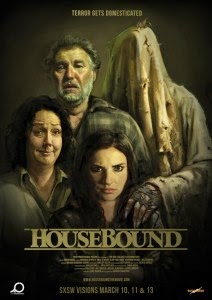
Film Review: Housebound (2014)

Copyright: Semi-Professional Pictures
Almost immediately, this film defines itself as, first and foremost, a comedy. In the opening sequence, a pair of ATM robbers is thwarted by a Bugs Bunny type mistake (and the subsequent hit in the head). Right after, the film jumps into the future, where one of them, a young woman named Kylie, is sentenced to house arrest.

The attitude filled Kylie returns to her family home, and to her mother, where she needs to spend 8 months wearing a locating device that will stop her from leaving the premise. Miriam, her mom, is happy to have her back, but the bad blood between them, located there since Kylie’s childhood, quickly begins to boil. But, at the same time, strange sounds can be heard in their old home, and this brings about bad memories of their previous family life where both believed at one point that the house was haunted.

Gerard Johnstone, the writer and director of Housebound, made just one mistake in the entire process, which is pretty amazing considering the budget and the relative lack of stardom in front of behind the camera. This mistake is the length of the film, and the fact that it loses steam on several occasions. 

Apart from this, the film is excellently written, using great characters which were presented in an awesome manner, mostly by Morgana O'Reilly and Rima Te Wiata as the mutually combative, hostile and very lifelike daughter-mother duo. O'Reilly especially delivers a finely tuned character in the form of negative Kylie, who is both obnoxious and likable at the same time.

Even weird decisions, like the strange influx of Tim Barton-like concepts at the last third of the film or the sudden turn towards a gory, splatter type of horror comedy, seem to work just fine for the Housebound movie. Better designed horrors like The Quiet Ones struggle to define their atmosphere, while this film effortlessly does the same, in spite of the fact that it seems like an improvised mash up.

I’m not sure is this because Johnstone had a very clear vision, or did the cards just fall in the right manner? In both cases, Housebound film works its horror/comedy magic all the way through.

MFM Interview: Tracey Birdsall

Dawn of the Crescent Moon (2014) is a supernatural thriller about a group of students who travel to Texas to explore a Comanche legend, but soon come face to face with it, staring Tracey Birdsall and Barry Corbin (watch the trailer here). Birdsall began her career more than three decades ago, and today presents a strong voices in the area of independent film.

Recently, I got an opportunity to talk to her about her new film and the inspiration it drew from Native American folklore, but also about the changing role of women in the movie industry.

Courtesy of traceybirdsallsmith.com
Movies, Films and Movies (MFM): Indie horrors are definitely a very interesting genre in the age of the Internet, both as a financial model and an opportunity for artistic expression. What is, from your perspective, the biggest advantage in working in this genre?

Tracey Birdsall: Indie horrors are very similar to the Science Fiction genre, where the audience has an insatiable appetite and will always give it a chance. It’s nice to work in all genres if you can - and experience it all, but I think the cult following of horrors and sci-fi is the biggest advantage to an actor. We love living the life of our roles, but having the movie seen by the masses and distributed is the ultimate goal which is much easier with indies in these genres.

(MFM): Looking at the trailer and the synopsis of your latest film Dawn of the Crescent Moon, many things (kids going to isolated locations, creepy local legends) seem a bit like Horror 101. What are, in your opinion, the strongest sides of this film that will transcend the usual horror tropes?

Tracey Birdsall: I believe one of the largest strengths that helps with that transcendence is that it is more supernatural thriller meets Gandhi (how’s that for a twist?!) It’s a horror film with a message which, although it’s from an Indian legend, it’s quite profound on many levels. I also think that having some good names, which are not tied to the horror genre specifically, will give it a broader appeal than most.

(MFM): Dawn of the Crescent Moon focuses on the Native American folklore and finds its inspiration there. Do you believe this part of the ancient American history can offer more to the movie industry in terms of ideas and concepts and in what ways?

Tracey Birdsall: I think that any time we can draw from true life inspirational history, folklore, legends, issues, etc. that it broadens our horizons, deepens storylines, helps people to understand and think about the concepts of the past (or present for that matter) and overall adds dimension to the movie industry. The Native American folklore in Dawn of the Crescent Moon sent me on a journey of researching it more for the purpose of understanding the film better. There’s a ton of fantastic material buried in all of that which could inspire a million screenwriters. It’s like religion without the stigma.

(MFM): Recently, we saw a huge uproar over the portrayal of women in video games called Gamergate, which produced a wide range of issues and clashing viewpoints. Yet, the same question can be easily transported to the movie business, where women are often presented as passive objects (more often than men). How would you characterize the evolution (or a lack of it) when it comes to genre issues in films, both in horror and in other genres?

Tracey Birdsall: I like to start the answer to that question with “I’ve never been one of those girls…!” I realize it’s like that out there to some degree, but I’m usually hired for roles that require wit, skill, and/or intelligence. Sometimes in comedy, for example, the joke is in being the passive object; however, that’s not the actress, it’s the role being portrayed and it’s oftentimes funny and quite challenging to prepare for. In horror, the women are quite frequently presented more as passive objects (or T&A as it used to be called) because that’s what the industry calls for - although I have noticed a decline in even that since the zombie revolution. In most things I get called in for, the roles have depth and substance and I never feel mistreated in any way. That said, I also don’t have any identity issues with how people feel about me. Even if I’m in a bikini (like I was a few months back), I still don’t feel like a passive object or have any issues with it… I just am thankful I went to the gym :) I realize some people get pigeonholed into parts where they might only get to play the passive object but that probably has more to do with how they are branded so they might have to tweak their marketing image. Once you’re branded, it’s pretty hard to change.

(MFM): What films should we eagerly expect from you next?

Tracey Birdsall: I just wrapped a film a couple of weeks ago called AT THE EDGE OF TIME. It’s a fantastic Science Fiction time travel movie set in multiple realities, so it was insanely fun to film and the costumes were really a blast… Next up is the lead role in another Science Fiction movie called PLANET CRASH. Directed by Neil Johnson, it takes place in the same universe as his previous cult hit films Humanity’s End and Alien Armageddon. Then in May, it’s off to the East Coast to film the new comedy WHO’S JENNA JAMESON? in the female lead role of Jenna Casey. There’s a couple more in the works, but that’s what’s in firmly right now!

(MFM): Thank you very much!

Keep up with Tracey Birdsall new projects on her official website, or follow her on Twitter.


Film Review: Summer of Blood

Summer of Blood is a film that can be described as a splatter horror written by Larry David. If this sounds like a compliment, it sounds correctly, because this film is probably one of the best horror comedies in 2014, especially if we consider that it was made on a super low (I’m guessing here) budget.

But, instead of Larry David, a man called Onur Tukel is the main motor behind the film, having written, directed and starred in it. Apart from David, I could see hints of Woody Allen (mainly in the notions of looser lusting attention from women) and other influences, but at the end it doesn’t matter where Tukel draws his inspiration.

The point is that he tapped the genre of conversational, socially awkward comedy with incredible success.

In the film, Tukel stars as Erik Sparrow, a lazy middle ag¬ed man who is scared of commitments and somewhat of a giant ass. One day, he gets bit by a vampire, which gives him Jedi-like powers. Using them, he starts to mostly have sex with women, and half-heartedly tries to fix his life.

During the film, Tukel is hilarious as the douchebag Erik, who remains because of this fact also very believable. He comments on pretty much everything that is going on, often coming out as incredibly obnoxious and cynical, while other people’s blood continues to splatter all over the place. The film doesn’t try too much to get into the gory/splatter domain, but does include plenty of red paint. Occasionally, important real-life ideas do come up, but they are immediately (and intentionally) squashed by some idiotic thing that Erik does.

Summer of Blood is an exceedingly entertaining film about selfish morons becoming selfish moronic vampires. Onur Tukel is without a doubt a great and witty writer, but he also managed to direct this film and steal the show as the main star.

Review and Ending Explanation: The Babadook

Copyright: Causeway Films
Being that 2014 is almost done, and I am not expecting any revolutionary new horror films, I can (almost) safely say that in my opinion, The Babadook is the best movie in this genre in the last 12 months. As a simple story, it delivers its punch right in the beating heart of terror with stunning precision, wherever that subconscious center might be.

Jennifer Kent directed this film, who is better known as an actress than a director. As a first time feature film, her directorial debut is pure horror shock and awe in the best possible way. Kent obviously understands art as a form of presenting content and emotion with as little noise or additional elements as possible. That is the reason why she made, first and foremost, an extremely elegant film that fits together like a brilliant architectural design. While I watched it, I had no inkling to fantasize about changing anything, and so far in this year, only Fury managed to lure me so effectively in its universe.

The Babadook offers a simple story about an emotionally tormented single mother Amelia, who is still haunted by the death of her husband on the eve of her giving birth to their son Samuel. Now, seven years on, Sam has a hard time fitting in with other children, and Amelia barely manages to balance her work and his needs. One night, she reads him a book called the Babadook, unknowing that it will summon a terrifying experience involving a shadowy creature with long pointy fingers and a top hat. Similar to Annabelle, the film bases its horror on children's accessories, in this case a pop-up book, and delivers a terrifying effect.

Kent knew perfectly well the aces in her hand, and she plays them mercilessly, to the joy of everyone who loves a great horror setup. Both Noah Wiseman and Essie Davis are brilliant as son and mother, and both impress in different stages. Wiseman works incredibly well for his young age, and Davis successfully transforms her character in a sudden, almost demonic fashion that aids the broader narrative perfectly.

The same tight control and deliver is seen in many individual shots in the film, where a depressing, somber home of the duo is shown. In gray, dirty white and blue colors, the house is the ideal stage for deep, ink-black shadows where things that knock three times lie in wait. The same is true for the Babadook book, which alone had the power to creep me out thoroughly. At the same time, Kent very smartly keeps the character count minimal, and decreasing as time progresses. The struggle in the Babadook is on Amelia’s and Sam’s alone, making it even more frightening.

The Conjuring really impressed me in 2013 as the horror which defined that year. I can say that this film did the same for 2014, but left an even stronger impression.

The Babadook Ending Explained

Spoiler Alert

For me, the explanation of the final sequence is relatively simple, and works as an analogy of Amelia’s emotional turbulence. The Babadook represents the torment of the mother, and her inability to resolve the feelings of the loss of her husband. As the book states, “the more you deny me, the stronger I get”, so does Amelia’s unreadiness to find closure continue to grow and even threaten her child in a case of a suicidal willingness to stop the emotional pain she feels.

Accepting this burden, which takes place in the final showdown, presents her personal transformation. She touches the hat, meaning she will not let it go, but as the spirit descends into the basement, Amelia accepts that it needs to be stored where it belongs – with memories, not with everyday life. It is still there, but she and Sam can live with it.

The last thing in this Babadook ending explanation is the bowl of worms. The last shot of feeding the Babadook worms that Sam dug up can be interpreted as the final, macabre proof that now Amelia knows where her husband really belongs – in the ground, were these creatures reside. If you have your own take on the ending of the Babadook, feel free to leave a comment.

Also, if you find Movies, Films and Movies blog interesting, stay up to date with new posts by liking its Facebook fan page.

Featured Video

Film Review: Le Fear 2 - Le Sequel

Copyright: Jason Croot
Le Fear 2 - Le Sequel is a film about the troubles of making a film with no budget and some amounts of dispersed talent. In it, Jason Croot, who directed the film and came up with the initial idea, tells the story of Carlos, a man who wants to make a horror film (actually, his 23rd movie of his career). He receives a shady offer that will cover the financial element of his production, but on the first day of shooting, realizes that he actually got a trailer home on a parking lot.

Soon, characters like young Nigerian swindlers and nymphomaniac (and slightly psychotic) make-up artist enter his project, and Carlos decides to soldier on in spite of the fact that he doesn’t have anything and is making something very similar to absolutely nothing.

The main problem of the film is the fact that almost everything is a bit too long. This is seen in gags, character encounters and even individual dialogue lines; jokes and the punch lines are there, but they are blunted by this constant notion of a prolonged introduction. I realize that the director aimed for, let’s call it, a long narrative exposure as the part of the inherent nature of the film, but it just becomes tiresome after a while.

There are signs that he tried to mend this by introducing ever more random elements to the Carlos directorial nightmare, including blow-up alien dolls on toy cars, but they all continue to fall into the feeling of comical fatigue. The film produces a great introduction early on, showing a shady agency where Carlos finds his producers, but quickly gets bogged down into characters standing around and arguing, while even more ludicrous characters stumble into the mix. This is a pattern that is used by Croot till the very end. On the other hand, the horror elements of the film are completely invisible.

The cast of the film does a good job, led by Kyri Saphiris who plays Carlos. But, the amount of sparks that need to fly between the characters for this setup to work needs to be similar to those seen in films like Living in Oblivion. This film also tells a story about a failing production for a small film, but its characters seem so in sync with each other that the entire thing breaths perfectly, even though it is nothing more than play filmed in a theater.

In some interesting fashion, Le Fear 2 - Le Sequel is the film that the fictional crew, led by the tragic Carlos, makes. It basic has a solid idea, but not remotely enough chemistry in its character interactions to justify the complete absence of any production values like a real movie set or a real camera (the entire film is filmed in a parking lot in an improvised mockumentary style). This was a bold move by Jason Croot, but in the end it managed to transform a smartly written script into a very flat film.

Film Review: Life after Beth

Copyright: A24
There is an emerging trend that offers a new incarnation of the horror comedy genre. Unlike its last versions from the late 80’s, where much focus was placed on slapstick and gore, the new films present a weird social enclosure in which the focus of the characters remains almost untouched by the events of the film, no matter how bloody or strange they become. These films present their own version of the reality where things like complex explanations of trivial occurrences or personal awkwardness remain relevant for the characters even while a horde of zombies bang on their door.

Summer of Blood is a perfect recent example of this notion, while some of it can be seen in films like This is the End and John Dies at the End. But Life after Beth is simply soaking in it, and thanks to it, the film provides a hilarious experience which only intensifies as the plot progresses.

In the film, a young man named Zach is devastated by the accidental death of his beloved girlfriend Beth. He tries to find some consolation with her laid back parents, until he notices that Beth is back at their home. He confronts all three; while Beth seems unaware of her resurrection; both her mother and father are bent on keeping this appearance of their daughter hidden, and demand that Zach plays along. He accepts, realizing that something much bigger and stranger is happening around them. Still, he remains oriented towards his relationship with the decomposing Beth.

There are so many fantastic comedic moments in this film that it is impossible to mention them all. The humor in Life after Beth includes situations of pointless and extremely unpleasant social interaction that look like they came straight from an episode of Curb Your Enthusiasm (along with the actress Cheryl Hines who also plays in the film). In other times, the film’s director Jeff Baena just stacks up characters and elements to a scene until it’s so preposterous that you can’t do anything but laugh.

His cast was chosen wisely, which means that everyone was up to the task when it comes to comedy. John C. Reilly is expectedly awesome as Beth’s dad who struggles to maintain some control, but the cast member who completely stole the show was Aubrey Plaza as the main corpse in the film. In the movie, Plaza alternates through many emotional states, often random, but was also ready to mix it up with some screaming and other equally visceral elements.

For a debut, Baena made a great film that really boldly stands on its own. Wisely, he steered clear of zombi apocalypse/romance reimagining plots like one in the film Warm Bodies. To watch Life after Beth is like queuing in line and listening to an older couple arguing in detail about their sex life and hearing how it includes a young Mexican wrestler, some fishing rods and a World of Warcraft gaming session. It might not come close to reality, but it is definitely an immensely fun experience.