Showing posts with label Thriller. Show all posts

Film Review: Child 44 (2015)

Copyright: Lionsgate
There are a lot of hard, fake-sounding Russian accents in this film. Imagine as if every male character tried to sound like an actor from the original C&C: Red Alert game – we’re talking weird emphasis on random words and a tendency to overly dramatize everything being said, because, apparently, that’s how people talked back in the dark days of the USSR. 

Its director Daniel Espinosa leaves this to be the strongest impression of the Child 44 film, which meanders through its characters and the soviet state that was organized, according to the film, in a very incoherent manner.

Its case is not helped by the fact that Tom Hardy and Gary Oldman lead a great cast, or the fact that Noomi Rapace once again creates an unusual and engaging character. This story of the film was moved to the big screen from a Tom Rob Smith’s novel by the same name. 

Like in his novel The Secret Speech, Smith analyzes the post-war soviet society to the level of the most miniscule details, which ultimately serves the story of the book. This gives the narrative both an environment-as-a-character feel, but also provides a twisted, but a logical motivation for many protagonists of his stories.

In the film, this makes the presented USSR only into an intangible bureaucratic hell, which is more confusing than scary – who is subordinate to whom and who is trying to get rid of Tom Hardy’s character – it’s all too convoluted to be truly entertaining and at the same time, it stopped me from creating a connection with the characters. Finally, all of this steals the story away from the series of murders that should be its backbone.

In a sense, presenting USSR in the early 50’s often comes out as a weird alternative history in which Nazi Germany won the war and simply told its visual graphics department to exchange the swastika for a red star. In Child 44, this notion is obvious and unlike Citizen X, which made me root for the investigators, turns all the characters into frightened and confused jerks in their own right. Because of this, the only thing I could say to Daniel Espinosa is – too bad, comrade.

Film Review: Good Kill (2014)

Copyright: IFC Films
A long time ago (speaking in video game industry terms) Ron Perlman declared in the opening segment of the Fallout franchise - war, war never changes. While the same might be true in a metaphysical sense, in a purely practical one, war definitely changes. 100 years ago, people still expected to charge the opposing forces using cavalry with real horses and real sabers (once such charge even took place in 1939 when the Polish forces carried this out in desperation). Today, however, people in the Western nations, especially the US, exchanged animals for a much more potent combat sidekick – robots.

Good Kill is about these killing machines, but it’s even more about a deep-rooted longing and ways how people get either lost in it or find a way out of it. The movie follows Ethan Hawke as Major Thomas Egan, a US pilot who was forced to exchange his F16 for a Predator drone.

Even though he is no longer deployed overseas, but does all his killing from an air-conditioned unit on an airfield near Las Vegas, Egan still feels as if a big chunk of him was ripped out when he was “grounded”.

While the days go by and Egan and his team plant hellfire seeds of death and destruction all over the world, he sinks into a dark place where all purpose is lost and ideals that were shaky at best become nonexistent. As Egan brilliantly puts it to his commanding officer, why are all the teams even wearing their flight suit when they are simply sitting in front of computers and pressing buttons.

Good Kill was directed and written by Andrew Niccol, whose interesting vision still continues to produce unusual movies which might not be grabbing as the run-of-the-mill AAA war-related production, but instead open personal questions. Like his old film Lord of War, Niccol seems really grounded in reality, no matter how gritty or unflattering it might be. Here, his cast supports the same vision really effectively, especially through Hawke and Zoƫ Kravitz, playing a young newcomer in the world of drone warriors.

As the real skies above places like Pakistan become more saturated with actual Predator drones, it is good to have films like Good Kill. They dare to try to make some sense of the rise of the killing machines, even if the answers are not geopolitical but instead takes place in a single man’s broken heart.

Film Review: Final Girl (2015)

Copyright: Cinedigm
Part proxy renege fantasy, part action film, Final Girl is a type of story that tries to produce a smooth visual experience, but offers very low amounts of substance. If follows Veronica, a specially trained killing machine who is planted in the midst of a group of young psychopaths who kidnap girls and hunt them in the forest as their own wrapped form of entertainment.

Veronica enters the pack and begins killing the killers and hunting the hunters. Sadly, this is the entire Final Girl film. As a narrative, it looks more as a draft of a story than the story itself, because it appears to be lacking any divergence from a single line plot. Of course, like Mad Max: Road Fury clearly showed, there is nothing wrong with a one-liner films, but only if they have a strong delivery. 

Even though Final Girl starts off in a somewhat intriguing manner, showing the young Veronica being interviewed by her future handler (played by the always creepily intense Wes Bentley) the intrigue does not last. The director Tyler Shields soon tries some interesting shots where he places characters really close to a background surface like a wall and shines a strong spotlight on them.

But then, the movie movies to a forest, where the action includes some whiskey laced with a hallucinogenic drug. Here, Shields gives us some half-cocked tense moments and drug-induced trips which seem to belong in a more ambitious student film. The only semi-impressive thing from that point on are Abigail Breslin (as Veronica) and Alexander Ludwig as the leader of the psychopath pack. The end comes fast and leaves almost no impression at all.

Final Girl includes some interesting moments and Tyler Shields should not be written off. But, as a whole, the film is utterly forgettable, aside from the fact that it shows that Abigail Breslin is now all grown up.

Current Shortcomings of True Detective Season 2

Copyright: HBO
I was trying to figure out what feels less than right in the new True Detective season. Like practically everyone, I really loved the Season one. From the first moment, it had that synergy of place and characters that was just magnetic in a sweaty, sticky, wrong way, but didn’t leave me feeling uncomfortable for a long time (maybe this is its only shortfall from being a truly groundbreaking show like The Wire).

Of course, I had big expectations from Season Two, especially because Collin Farrell (ever since I saw Tigerland, I am certain that the man is a great but underappreciated actor). But, at the same time, I knew that replicating the formula from the first seasons would be impossible, so I was just hoping for something interesting. 

For the first couple of episodes, I wasn’t even sure that anything feels wrong or inadequate. After all, just a year later, I forgot what happened in the first season’s episodes (for example, what exactly takes place in episode 3 in the first season?), so I told myself that this is a normal buildup process of the Pizzolatto type.

But after the episode five, I think I finally managed to transform vague feelings into words. It turns out that Season Two of True Detective simply misses many key moments from Season One, but fails to add other elements that could replace them when it comes to the pure factor of engagement found in the show. On the other hand, its characters do not succeed in hooking the audience with one major hook but try throwing many smaller ones, which don’t connect that well. Here are some of the key points of the current Season Two lack of engagement:

Season One had the Yellow king, a ritualistic murder and creepy drawings which were all powerful but unclear symbols. Season Two has none of these and even the main murder mystery is easily forgettable.

Season One had that strong idea that something in the show might be supernatural. Rust Cohle had his visions, the Yellow King had its presence and these blended into an atmosphere of eerie, dark wonder. Season Two has highways and illegal immigrants looking sad.

Character relationships are deeply undeveloped because of lack of screen time and too many character threads. For example, why would Ray Velcoro and Paul Woodrugh care about each other? In the first 5 episodes, they had like 5 minutes of mutual conversations.

Season One used direct narration to foreshadow and intrigue, without giving anything away in any meaningful form. Granted, the same pattern was a one-time trick, but Season Two didn’t try to pull its own trick so far.

Finally, Season One didn’t have Vince Vaughn, which was, in retrospective, a huge plus. Let’s face it, the man is just saying his lines and there’s none of that “I’m changing my career here” fire. Imagine him smiling a lot more and he could walk right into the set of Wedding Crashers 2.

This all does not mean that True Detective Season Two cannot become something great. But the window of opportunity for that is becoming smaller and smaller, while at the same time, the narrative turn that might be coming has only to become bigger and bigger so that it could really impress us.

Film Review: Maggie (2015)

Copyright: Lionsgate Films
We didn’t realize it, but a zombie apocalypse is an apparently full of depressive potential. Sure, the plots often grazed depression in these types of films, but mostly while their primary emotions are based on anxiety and the need to stay alive. In Maggie, however, the focus is exclusively on depressive shades of a deadly virus outbreak, which turns people into flesh-craving monsters.

To add to the unexpected weirdness of this idea, the film introduces Arnold Schwarzenegger as Wade, the bewildered father of the main character, a girl called Maggie, who gets infected with the virus and has only weeks before she turns into a zombie. On their secluded farm, father and daughter prepare for the inevitable while Maggie says goodbye to her memories and everything around here.

When Henry Hobson directed this film, I’m certain he wanted to make something original above everything else. He managed to do this, but also to cram some nice melancholic tones in this primarily depressive story about loss and change.

At the same time, I’m sure he enraged many people and will enrage others in the future who will be expecting to see Arnold blowing away zombies. In the film, Schwarzenegger is a quiet, truck-repairing type of guy who is preparing to put his dead daughter into the ground or do something even worse. He runs with this notion neither too badly not exactly excelling in his role. Instead, he does okay, which can be said for the entire movie as well.

Hobson obviously has some ideas and Maggie shows this, but as a whole, it keeps an aura of casual meekness which stops it from making some serious emotional impacts, unlike, for example, The Retrieval, which shares its toned-down narrative approach and bleakness. Abigail Breslin is really sharp as Maggie, but the film somehow is not. It’s good that Hobson did not try to say anything about the genre of zombie movies as a whole and simply drove the plot a personal story. It might not have Schwarzenegger raining destruction, but at least it is trying to destroy our emotions by showing a really horrible few weeks for a single family.

Film Review: The Lazarus Effect (2015)

Copyright: Relativity Media
Like the recent horrors which were both low budget (Spring) and really AAA level (Poltergeist) this film is also significantly uneven. From the basic story of a lab team that developed a cure for death, The Lazarus Effect quickly slips into a thriller of demonic possession and personal hellscapes. The speed of this transition is not only narrative, but also quite literal, because the entire film lasts well under 90 minutes.

The cast of the film, mainly Olivia Wilde as the lead actress, glides through the action smoothly. With a couple of short stops on the regular horror path of “everything is just fine” to “we’re losing our budget” and “the short-sighted administrators put a stop to our brilliant research”, to the final “OMG we killed our colleague”, the film presents the expected milestones.

Then, the reign of terror commences and fills the really small space of the laboratory (the film practically stays in 100 square meters of lab rooms). Here, Wilde brings most of the frights (the strongest suit of the plot), but this is still no enough to help director David Gelb in making anything more than a modern TV version of Flatliners.

On the other hand, like the film Devil from 2010, The Lazarus Effect does pretty well for a film where special effects and locations did not cost the production very much. Instead, Gleb used the actors and a fast tempo of the plot to make an average, but enjoyable horror on a 3 million dollar budget. Not counting the recent and brilliant It Follows, which also had a miniature budget, this is really low for a film with famous Hollywood actors.

While it is not great by any account, it is too short to really be bad, which is a solid result for a not very ambitious horror and also a production lesson for anyone looking to make financially successful films (The Lazarus Effect made 10 million during its opening weekend).


So Bad it’s Good: The Counselor (2013)

Copyright: 20th Century Fox
Many films demand a certain state of mind if they are to be experienced to the fullest. For the Counselor, that state of mind should be something between feeling very sleepy and being exceedingly agitated. In this golden zone of inactivity (sleep) and frantic activity fueled by anxiety and frustration (agitation), it produces a unique experience. Here, the film shines like a true diamond of total overconfidence, in spite of the fact that it was built on devastate foundations of a script that is not simply overly ambitious, but aims for the spot of a modern masterpiece. The result is a funny and pointless film, but not because of its plot holes and illogical series of events, but because it seems to believe that not many thrillers of modern time can be compared with it.

This is seen from the first moment when the basic relations are set. In it, Michael Fassbender plays a successful attorney and a man who desires to get into drug trafficking, but knows nothing of it. Javier Bardem plays Reiner, his guide on this perilous journey, who has more experience and a lot better fashion style. Together, they initiate a financial series of events that gradually summon a Mexican cartel to their lives when all begins to fall apart.

Aside from these two incredible actors, there are many other who know their craft, but nothing of this is relevant next to the script. Here, the writer, who is a brilliant man by the name of Cormac McCarthy, a man who created the masterpiece called The Blood Meridian, managed to cook up a mixture of speeches which are all twice as large as life. Everything in the film is followed by a witty narrative segment and every line is not only a punch line, but a wrecking ball when it comes to its desired impact. In every minute, some character says something worthy of Cesar or Napoleon during their most important battles, and the sheer amount of serious situations clutters everything. 

The film’s director Ridley Scott, just like in the case of Prometheus, once again fails to successfully wrestle with inadequate scripts and instead tries to glide through them, resulting in complete calamity. When the talking stops, the film switched gears into a gritty action film with bursts of Uzi automatic fire and machine-induced beheadings, which makes even less sense then the overspent cerebral approach and mastery of introspection, which is a trait of every character that appears on screen for more than one minute.

In some variations, the McCarthy’s script would work, if the setting was rural Arizona where everyone was dirt poor, but still behaved like a Harvard philosophy professor without any explanation who this came to be. Rian Johnson and his movie Brick managed to pull this off a decade ago. But when McCarthy’s work was brought to life using Scott’s blockbuster approach and set in a super-glamorous setting, it lost all meaning and become infused with presumptuousness that is rarely seen in this magnitude. Unlike other badly devised but presumptuous films like Before I Go to Sleep, this one is not flawed when it comes to its story. This is definitely a plus, but at the end, as Linking Park says, it doesn’t really matter. 

The Counselor is a hilarious concoction that can only be enjoyed as a disfigured reminder that some things don’t work well together, even if they are great separately. Also, it is a reminder that Ridley Scott really didn’t make a good film since the American Gangster.

Film Review: Poltergeist (2015)

Copyright: 20th Century Fox
Poltergeist from 1982 is one of those films that are etched into the hearts of many generations. Here, Spielberg showed how horror and utter amazement can go hand in hand while it also generated incredible amounts of money. Naturally, topping that for any would-be re-imagining is a pretty big deal, which is why, it seems to me, the creators of Poltergeist 2015 really didn’t even try.

I have to say right off the bat that I really loved this film. It has some awesome visual moments, mainly where the light from objects is used as a material element, not as something untouchable. Here, the director Gil Kenan really presented some impressive moves, which are not overproduced or hammered upon the audience by the 3D setting.

At the same time, many problematic things that often show up in horror films, like obnoxious little children or the irresistible need to make the actions of the protagonists logical (they never are and we’re never convinced as the viewers by the explanations) are completely excluded. From the first moment a child disappears, the parents are like: “This is supernatural. We have to call the Ghostbusters.”

A minute later, Ghostbusters (in this case a team from the local university) show up and say “Yep, these are ghosts you have here. Even worse, they are a Poltergeist. We have to call a Ghostbusters specialist.” Soon after, a specialist appears, played by Jared Harris, who is also immediately assured that stuff is supernatural to the max. Fortunately, Harris got to try out this role, minus the humor and benevolence, in The Quiet Ones, and does a decent job, unlike others, but more about this later.

This approach is really liberating from the regular horror ebb and flow of belief/disbelief which I find more and more to be pointless and dull. It allows the Poltergeist movie to evolve as a ride and provide ample amounts of satisfying twists and turns, although nothing that will make James Wan wants to steal a trick or two for his next film.

But, I completely understand why many did not like the film. Firstly, it copies the narrative of the original play by play, adding only stuff like iPad controlled camera-carrying drones, which is kind of lame. It also has this weird imbalance of production values. Because of it, the house where the action takes place looks painfully boring, along with its surroundings. While the first film made a huge deal about this transformation of the suburban landscape into a hell portal, Poltergeist 2015 fails to pull off anything similar to this idea. The house that is featured in it begins as a boring home and ends up as a boring exploded home, which isn’t much of a story arc for it.

Lastly, there is the issue of Sam Rockwell as Eric Bowen, the father and husband of the family. I really love Rockwell as a character actor, but he was a serious miscast for this film. Throughout the film, he emits an ironic, detached feel that is completely out of his character’s supposed frame of mind. His many dry remarks not only fail to produce humor, but also make it harder for the audience to be immersed in the plight of the Bowen family. I’m not sure why Rockwell accepted the role, but he sure seems like he wanted to do something else.

This, along with the production issues, tells me that Gil Kenan fully understood that he wasn’t making the “next” Poltergeist and instead he tried his best to make “another” Poltergeist film.

The Poltergeist full movie was something that I very much enjoyed, but most of that came from expecting to see weird and scary things in a setting that was familiar to me. While I wish it to be enjoyable for others as well, it is by no means a great horror film.

Film Review: Ex Machina (2015)

Copyright: A24
When I heard about Ex Machina, I was really looking forward to seeing it, mainly because of one name – Alex Garland. 

As an experienced writer, Garland worked on a number of sci-fi-ish things, including excellent films by Danny Boyle. But, when I saw it, I realized that the whole film indeed resides on a single name, but that’s not Garland, but one of its three main actors, Oscar Isaac.

In the film’s plot, a young coder meets a strange and reclusive IT genius who is working on a secret project in his mountain villa/research complex. There, the same coder meets Ava, an AI in the form of a robot. His task is to use the Turing test and determine if she/it is really fully conscious and self-aware.

Garland made Ex Machina like he would write a novel. The dialogues are smart and dependent on the notion that no one in the audience actually knows much about the Turing test (film tries to brush this aside, but doesn’t do a great job at it). The characters are layered and the Machiavellian plots are ripe all over the place. But, in the end, Alicia Vikander just does not show anything else than a robot. This machine-to-human transition is exceedingly difficult and often fails when it is approached directly and head-on. On the other hand, films like Her, who approach it sideways and through relatable characters, tell the basic Ex Machina story in a much better way.

The only great thing going for Garland in the film is Isaac. After A Most Violent Year, I can easily say that this man has all that is needed for a very cerebral acting star. His character is distant as any imaginary tech genius and possibly a sociopath, but also someone who the audience can practically touch through the screen. Isaac glides thought the role, unlike the other two characters.

Ex Machina feels and delivers like any Twilight TV show episode would – there is some cool cinematography, some tension and a heavy-hitting twist, but all failed to impress as a whole.

Coming Soon - Mad Max: Fury Road

The critics who managed to see the film love it and all the footage and trailers we saw pointed to the same conclusion - Mad Max: Fury Road will be one hell of a film - from the violence to the beautiful cinematography and crazy action choreography, it's all here. It is coming out in a matter of days, so be ready to start planning to go and see it once it hits the theaters on May, 15. 

To get into the mood (unless you want to stay pure until you see it on the big screen) here is Mad Max: Fury Road Official Retaliate Trailer.


Coming Soon - Monsters: Dark Continent

A few years back, when Monsters came out, it really made an impact on me as a slow-moving, indie drama/social commentary set in a very imaginative science fiction world. Now, Monsters: Dark Continent takes place a decade later when the alien infection spread to the rest of the world.

This time the plot is set in the Middle East, where a US army fights both an insurgency and the aliens at the same time. I'm hoping that some of the same grim feel and subtle US foreign policies metaphors that the original included will be present in this part as well.

Tom Green is directing the film as his first full-length piece, which comes out today, on April 17, in the US theaters. Check out the trailer for Monsters: Dark Continent below.

Coming Soon: Ex Machina (2015)

Copyright: A24 Films
For me, the most important thing about Ex Machina is its writer/director Alex Garland. Garland already proved himself as a great writer in films like Sunshine and 28 Days Later.

Now, he is making his directorial debut in a story about a reclusive computer genius who summons a younger computer genius named Caleb to his mountain home. There, Caleb discovers a synthetic life form called Ava that might or might not be fully self-aware, sparking the plot of this compact-looking sci-fi thriller.

Ex Machina comes out in the US on the 10th of April and you can watch its trailer below.

Film Review: Chappie (2015)

Copyright: Columbia Pictures
So far, Neill Blomkamp’s films weren’t works of art that felt completely organic to me.  When District 9 was hailed as the future of a gritty, dark, socially sentient science fiction, I wasn’t convinced that it truly had a real message to transmit. Instead, it seemed to me that Blomkamp figured out how his work can seem deep and meaningful while it had nothing new to say, apart from the fact that people tend to be racists and savage in many different circumstances.

His new film Elysium was, for me, the crown evidence for this theory. In this awkward mixture of Hollywood A-list actors and high-budget CGI, Blomkamp delivered a shallow story that neither sold its drama nor its action. It was District 9 all over again, but it lacked the charm of a small production set in a real exotic, turbulent location.

This is why I was even less excited when I heard that the same director was making a movie called Chappie. To me, it seemed like he decided to retreat even further back into his original breakthrough film and I doubted it could result in something interesting. I was completely wrong about that.

In Chappie, Blomkamp dug deep to reconnect with a totally personal narrative, free of forced social commentary. In his new film, a tale of a police robot that gets hijacked and reprogrammed so it develops full consciousness, is funny and fun, but still managed to deeply resonate with something in me which differentiates between a living thing, and those things that are not alive (or so I judge them).

In the whirlwind that follows after the mechanical birth of Chappie, the childlike robot is left with Ninja and Yolandi, South African street gangster (and in real life, two of the core members of a band Die Antwoord). These two act as surrogate parents to the intellectually young Chappie, who grows up in a matter of days under their completely opposite directions. The additional element is Deon, a young and idealistic programmer who created Chappie’s intelligence and dreads to see him joining a criminal lifestyle.

In its course, the film deals with the nature of life, death, violence, creativity and the needs of individuals that come into conflict with the needs of others around them. At moments, Chappie’s growing up is hilarious (the segment with stealing cars), while in others it is totally terrifying and even disturbing. All these ideas are fantastically presented by the incredible acting skills of both Yolandi and Ninja. I knew that they were great performers, but in Chappie they show an impressive range that covers deadly serious, sadistic to a scary level and completely goofy, especially in Ninja’s case.

The larger narrative ideas of the plot seem irrelevant when they are is compared to the character of Chappie itself. Like Wall-E and other great robot characters, I experienced the film from his perspective and it was an impressive ride. For me, the entire Chappie movie was a vessel that delivered a complex, believable character to whom I could relate completely, even though he (or it) is not even a human being.

Film Review: Black Sea (2014)

Copyright: Universal International Pictures
If submarine movies taught us anything, it is that the bottom of a sea is a great place to die in many different and colorful ways. Starting with drowning, exploding and suffocating, there is no doubt that submarines in films usually present steel coffins in which people rarely experience anything nice.

Black Sea brings about a similar idea, but places it outside of a military context. In its plot, there is no World War II or even a Cold War. Instead, the film takes place in the present day, where a washed out (pun not intended) salvage submarine captain called Robinson loses his job and then accepts a shady offer of taking a boat to the bottom of the Black sea near the Georgian coast, where allegedly a German U-boat sub has lain since 1941, full of dead German submariners, but also 2 tons of gold bars.

Robinson agrees, takes a crew of Westerners and Russians and sails to the location, where he needs to get the gold, but also dodge the Russian Navy. In no time at all, the whole idea of how all subs are submariner’s coffins begins to take its familiar form.

Directed by Kevin Macdonald, the Black Sea movie brings about an interesting twist to this genre, while it also manages to create something of a sub-genre that can be called a civilian salvage underwater thriller. With a good cast lead by Jude Law, but also by the very impressive Ben Mendelsohn and Scoot McNairy, translating this script into a film was not a huge challenge. Like in his recent film How I Live Now, Macdonald is apt in presenting a simple plot in a fresh way.

Here as well, while the story does have many plot holes and adventure tropes (like the moment where Captain Robinson brings along a completely unskilled young man on the mission, mainly out of pity), the overall dynamic of the film leaves the viewer interested in the characters on a very basic level. Also, Macdonald steers clear of overplaying dramatic segments which could have easily sunk this film (it’s easy to make sea-related puns when writing about submarine films).

The best thing about the Black Sea movie is the fact that it brings a focused thriller full of hard-boiled submariner-type characters, free of any unnecessary cinematic noise. Like the narratively completely different Maps to the Stars, this film pulls the viewers in and keeps them near all the way to the end.

Coming Soon: Man From Reno

Directed by Dave Boyle, Man from Reno is a thriller about two separate stories set in California, connected by the notion of one particular Asian country – first one is an random road accident that includes a sheriff from a small town and a Japanese man, while the other follows a fiction writer from Japan who travels to San Francisco to escape the media pressure of her new book release.

From the trailer, it looks like Boyle created a minimalist thriller with a strong sense of a compact mystery. Currently, the film is hitting the festival circuit, but I’m guessing it will find a wider release date very soon.

Check out Man From Reno trailer below.

Coming Soon: The Gunman

Although Sean Penn isn't an actor who is immediately associated with action films, he looks perfectly suitable in The Gunman. The effectively named film is hitting theaters on March 20th and seems like an engaging spy-gone-rogue action thriller. Aside from Penn, the cast is led by Idris Elba, Javier Bardem, and Ray Winstone, and directed by Pierre Morel, who made the first film in the Taken trilogy (he was dearly missed in the lukewarm Taken 3).

Check out the Gunman trailer below.

Film Review: Board to Death (2015)

Copyright: Broken Lens Production
Wife.
Life.
Death.

A lot of cool sounding things come from Board to Death, a short indie neo-noir thriller made by a Broken Lens Production, a production company made up from young filmmakers. The film’s director Dammie Akinmola created a very simple thriller black and white piece about a crazed husband who is determined to kill all those who have disrespected his beautiful but very insidiously quiet wife.

With this film, Akinmola showed that he really can pack a tight frame and position the camera (and even its motion, which is always tricky for small productions) so it shows all the hallmarks of the noir genre.

At moments, the film seems like a raw version of Sin City: A Dame to Kill For before the CGI is plastered over the actors. Here, the film really shines as a mute piece about a dangerous man in bleak surroundings.

But, once the plot begins to unravel, Board to Death becomes more constrained and slightly less focused. With the use of heavy narration provided by the main character, the audience is drawn through the story like a child through a museum that was deemed too complicated for it. Here, Akinmola also decided that things should be both shown and told, which is not a great direction for a movie that drives towards a noir feel.

During his killings, the main character explains things both in person and to the audience, killing not only his victims, but also the noir atmosphere. The only thing which offers an alternative to this blatantly verbal approach is the board which is used by the wife to show the husband who he needs to kill. But, the board is also a Scrabble type of game, which results in even more words for the viewers.

Board to Death is a tight looking film, but which sounds as one that thought it should be even tighter. On the other hand, it needs to be said that the aim of Akinmola and Broken Lens Production was respectably high and most importantly, it shows skill and knowledge that can result in even better films to come.

Movie Review: The Imitation Game (2014)

Copyright: The Weinstein Company
Alan Turing had it rough, but it was all kind of worth it. This is, in a nutshell, the idea that I got from the film The Imitation Game. This story about the king of computer geniuses of the first half of the 20th century is very polished and the cherry on its top is Benedict Cumberbatch, who is a great actor and the next gigantic crush for all those boys and girls who really loved Ryan Gosling before he became really popular.

Yes, everything is here and all it very compacted and easily digestible, but somehow, for me, something was very lacking and very off in this film. Its director, Morten Tyldum, had a similar effect on me with his previously best-known film Hodejegerne. In it, just like in The Imitation Game movie, I have a feeling that Tyldum strives for bedazzlement and charm, all in a desperate attempt to leave the audience without too many questions, mainly, what did we really learn about its main characters?

Here, the same problem arises. What drives Alan Turing and why is practically everyone his enemy or at best, passing annoyance? The film provides two parallel vectors that never merge into a single human being: one side of Turing cares only for his machine that can decipher the Enigma code, while the other side is forever haunted by his personality that is simply unwelcome in that time and place (primarily his sexual orientation).

Here, the film backs off, not allowing Cumberbatch to make a choice as Turing. He is neither fine with who he is nor is he tormented by it. He is calculated and even cruel in his worldview, but offers a soft human side on practically every corner. He desires to make beautiful computers that can become aware one day, but he also desires to find boyfriends in the local pub. He is everything that the real Turing was supposed to be, but nothing of this truly defines him, mainly because the film doesn’t show him sacrificing anything willingly. Things and people just fall out of his life, but he marches on, even when his supposed life purpose is completed.

A lot of Tyldum’s careful constructed facade that plasters the inherent emptiness and gutlessness of the film is seen in its soundtrack. At some moments, it is sad, while other times it is cheerful, but throughout the film, it remains very whimsical, as if it seeped from a blockbuster film like Gravity, where the music is used to underline the pacing of the action for those who have trouble concentrating on it while they make out, eat popcorn or use their smartphones.

I don’t know much about what kind of man Alan Turing was, but I am also certain that I learned or felt nothing more about him after I watched The Imitation Game.

Film Review: Taken 3 (2014)

Copyright: 20th Century Fox
The Taken franchise seemed very interesting back in 2008, when it brought a cool and minimal plot, featuring the ideally cast Liam Neeson as Bryan Mills, an ex-something-dangerous-and-murder-enabled man, but also a dad whose daughter gets kidnapped in Paris. The rest of the film covered Bryan hunting and killing his way to the end goal.

In this constellation, Taken worked perfectly while it balanced between ultraviolence and a regular action thriller. Neeson, who became very proficient in this type of role, which variation was recently seen in the A Walk Among the Tombstones, added the right kind of style and sealed the deal. The sequel pretty much did the same thing, but Taken 3, the ending of the trilogy, goes completely off its old playbook and because of that, ruins the fun.

Now, Bryan is his home in the Los Angeles area, where he lives separated from his wife, trying to be a good dad to her college-going daughter. One day, all this goes to hell when he comes back home and finds something terrible in his bed. The police burst in, believing he is responsible for the crime they find. Bryan does his ex-something Kung-Fu and flees the scene, determined to get to the truth by producing a pile of corpses that belong to one or another East-European crime syndicate.

Director of the film, Olivier Megaton, definitely made two huge mistakes that gutted this film of much fun. First one is a strange editing process which destroys every car-chase scene with a badly positioned camera (that is too close to the vehicles) and fast, maniacal cuts that stack up until the vehicles finally come to a halt. In every car sequence, the same thing occurs as if Megaton thought that he needed to cover bad stunt driving scenes by cutting everything in milliseconds and filling it with tons of motion blur effect. But then, weirdly, the ending car chase was shot and edited perfectly, apart from the fact that its setup is very original (this is the best element of the film by far).

The other problematic feature of Taken 3 is its lack of narrative direction. First half an hour are filled with family drama that builds tension, but also muddies the waters when it comes to defining a clear antagonist of the story (which is a necessity in these setups). Later, it mutates in a Fugitive-type of film, where Bryan dodges cops and investigates gas stations, making us wonder who he is really fighting against. Somewhat of a similar mashup can be seen in Cold in July, only Taken 3 doesn’t have its strange but strong charm. Instead of rushing through this part of the story, Megaton takes it slow, killing with this the winning and recognizable Taken dynamic.

It tries to go for red herring characters, but this comes off as a waste of time and completely nullifies the laser-precise plot development of the first film. Taken 3 full movie feels like an action film that struggles with this fact and covertly aspires to be something more. The character of Franck Dotzler, played by Forest Whitaker, is a good example of this thought. Whitaker performs Dotzler in a solid manner, but his purpose in the film turns out to be nothing more than stealing screen-time from the real bad guys.

With a slow, watered-down script and a few sub-standard action scenes, Taken 3 ends the series on a very low note.

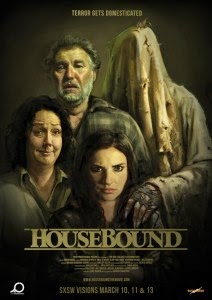
Film Review: Housebound (2014)

Copyright: Semi-Professional Pictures
Almost immediately, this film defines itself as, first and foremost, a comedy. In the opening sequence, a pair of ATM robbers is thwarted by a Bugs Bunny type mistake (and the subsequent hit in the head). Right after, the film jumps into the future, where one of them, a young woman named Kylie, is sentenced to house arrest.

The attitude filled Kylie returns to her family home, and to her mother, where she needs to spend 8 months wearing a locating device that will stop her from leaving the premise. Miriam, her mom, is happy to have her back, but the bad blood between them, located there since Kylie’s childhood, quickly begins to boil. But, at the same time, strange sounds can be heard in their old home, and this brings about bad memories of their previous family life where both believed at one point that the house was haunted.

Gerard Johnstone, the writer and director of Housebound, made just one mistake in the entire process, which is pretty amazing considering the budget and the relative lack of stardom in front of behind the camera. This mistake is the length of the film, and the fact that it loses steam on several occasions. 

Apart from this, the film is excellently written, using great characters which were presented in an awesome manner, mostly by Morgana O'Reilly and Rima Te Wiata as the mutually combative, hostile and very lifelike daughter-mother duo. O'Reilly especially delivers a finely tuned character in the form of negative Kylie, who is both obnoxious and likable at the same time.

Even weird decisions, like the strange influx of Tim Barton-like concepts at the last third of the film or the sudden turn towards a gory, splatter type of horror comedy, seem to work just fine for the Housebound movie. Better designed horrors like The Quiet Ones struggle to define their atmosphere, while this film effortlessly does the same, in spite of the fact that it seems like an improvised mash up.

I’m not sure is this because Johnstone had a very clear vision, or did the cards just fall in the right manner? In both cases, Housebound film works its horror/comedy magic all the way through.